|
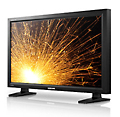
Introducing the latest in plasma and display
technology from Samsung. With incredible image quality and versatile
inputs, the plasma line of display products comes in three sizes:
42-inch, 50-inch and the world's largest plasma
display, the 63-inch. Featuring a real-time clock, digital
(10x) zoom, picture-in-picture, variable viewing modes, and auto pixel
shift these plasmas offer nothing less than what you would expect from
the world's number one manufacturer of display products. All Samsung
plasmas come with a 2-year on-site warranty as well as 24 hour, around
the clock technical support. |

www.samsungusa.com
Flat Panel Display
Flat Panel Display sets a new standard in
premium digital television, offering a fresh alternative with lifelike
sensations on a slim screen that dwarfs what was once considered 'large
screen'. Overcoming the limits of bulky box TVs, this Samsung's super
slim ultra-light subtlety creates a unique entertainment environment
with a clean, simple display solution. This new creation and digital
experience are delivered with perfect digital picture quality. Samsung
Plasma TVs will heighten your senses, intensifying your total experience
to the outer limit.
Samsung plasma Display technology
Samsung's unceasing efforts in plasma
technology have redefined the standards of Flat Panel monitors produced the
63" largest Plasma TV or incredibly slim design Plasma TVs.
Samsung Plasma Screen
Plasma Display is a bit of technological
brilliance that makes large screens come alive, while projecting you
into a new dimension of distinction with its exceedingly slim, perfectly
flat, and amazingly vivid image. Plasma Screen is generated through total
internal digital processing. When the monitor turns on, the two address
electrode panels cause gas to change to a plasma state and illuminate UV
light. Then Red Green and Blue phosphor filters absorb the UV light and
re-radiate it as visible light. The self-illuminating system of Plasma
Display delivers a totally vivid image.
About Digital Television
The analog method that has been used up
to this point, refers to transmitting the brightness of light and
loudness of sound as they are by expressing as electric voltage.
Digital Television, on the other hand, means
transmitting via digital transmission method after digitally processing
everything, including video, audio, and data.
Digital processing refers to conversion
of an analog signal, such as video, audio, and data, into a digital
signal composed of 0 and 1. This is accomplished through the use of
highly advanced digital technology. A converted signal is compressed,
along with other information, and transmitted via the digital
transmission method. The transmitted signal is separated into the
original video and audio, and then decompressed (demultiplexing &
decoding) at the receiver. In other words, all information is converted
into numbers and then sent and received. As long as a 1 is sent and can
be recognized as a 1 from the receiving end, there will not be any
problem in converting the signal back to its original state, regardless
of whether there was static or signal deformation in transit.
|
|
|
Analog TV |
|
|
|
|
|
Scan Lines |
|
525 |
|
|
480x704 |
|
1080x1920 |
| |
|
|
|
480x640 |
|
720x1280 |
|
|
|
Screen ratio
|
|
4:3 |
|
|
|
|
Picture Quality
|
|
Normal |
|
|
|
|
Sound
|
|
2channel, stereo |
|
5.1channel/ surround |
Digital can be classified as HDTV (high
definition television) and SDTV (standard definition television). HDTV is a
high-resolution Television method supporting a 16:9 screen ratio and Dolby
digital surround audio. It has 1080 scan lines (interlaced scan) and is
capable of receiving 18 types of digital broadcasting. Thus, this method
can be said to be capable of clear picture, marginal picture flickering,
and abundant expression of color tones.
SDTV is a digital television method with
relatively lower resolution, with 480 scan lines. A screen ratio is not
specified. But since SDTV is also a digital method, it supports sharp
picture quality and uses less frequency bandwidth than HDTV. SDTV is a
good method for simultaneously supporting interactive services, such as
data broadcasting, simultaneous broadcasting, and VOD (Video-On-Demand).
Digital broadcasting based on digital
technologies has advantages over analog TV, such as strength against
static and efficient information transmission.
The advantage considered to be the most
innovative of digital TV is their functionality as a two-way multimedia
terminal. Since all information is processed digitally, not only
Internet access (web browsing) via TV but also data search while viewing
programs (multi-windowing), will be possible. When the digital TV is
connected to the outside, a wide range of two-way value-added services
can be provided through them. As the TV that used to be a one-way visual
entertainment device transforms into a cutting-edge informational device
with two-way multimedia functionality, the status that TV assume within
people's home is expected to change as well. Digital TVs are
data-compatible with devices that process signals digitally, including
digital multi-function DVD players, digital camcorders, and digital
VCRs. Therefore, digital TV is being touted to work as the nerve center
of a home, which all digital devices at home are connected as one
network. |